Bonzo
Pamela's WarBonzo is Pamela Wheeler Fellows’s little brown terrier and her closest childhood companion. Given to soften the disruption of a move, he becomes far more than a pet: he sleeps on her bed, waits for her return from school, accompanies her in the car, and gives her an intimacy and constancy that war will eventually destroy. His comic cleverness makes him memorable, but his death in the darkness of the hotel car park gives his story its decisive significance. Bonzo embodies the ordinary love that wartime conditions place at risk, and his loss becomes Pamela’s first encounter with grief that cannot be repaired or explained away.
Identity and Arrival
Bonzo enters the family as a small brown terrier puppy, promised and then presented to Pamela partly because children are notoriously resistant to change. The gift is therefore both an animal companion and a strategy for making relocation bearable. The arrangement quickly exceeds its original purpose. Bonzo becomes Pamela’s very best friend; he sleeps on her bed, and the two become inseparable. His presence gives the new household a stable emotional centre while the surrounding world remains subject to movement and uncertainty.
Bonzo’s first major crisis comes soon after his arrival, when he nearly dies of distemper, a serious puppy illness that is generally fatal. Pamela’s Father treats him with brandy and advocaat, administering the improvised cure over time until Bonzo recovers and begins to thrive. The recovery gives his survival an almost miraculous quality, reinforced when a local owner tries the same treatment on another puppy and reports that it works. Bonzo is consequently established not as a fragile background pet but as a creature whose life is actively protected and whose recovery becomes part of local anecdote.
Character and Comic Intelligence
Bonzo’s life outside the family is expansive. He reluctantly allows Pamela to leave for the morning bus, then waits for her return, but her absence does not make his days empty. He explores the neighbourhood, makes friends among the local dogs, and is rumoured to father puppies whose colouring and features resemble his own. The suggestion enlarges him from a household animal into a local presence with a canine social world of his own.
His intelligence is repeatedly paired with questionable morals. A shop beside the hotel displays walnuts outside, and Bonzo regularly steals them, carrying each prize to a quiet place where he can crunch it in peace before returning for another. The grocer points out that the dog is consuming what little profit the struggling shopkeeper has, so the walnuts are moved beyond Bonzo’s reach. The episode captures the tension that defines him: his conduct is plainly harmful, yet the methodical return, retreat, and replenishment also reveal resourcefulness and purpose.
Bonzo understands spoken instructions with remarkable precision. When Pamela’s Mother, wanting an afternoon nap, tells him to go and get her a chookie in the hope of sending him out of the room, the trick produces the opposite result. Before long, Bonzo ceremoniously deposits a large white chicken on the lawn beneath her bedroom window. It is indeed a chicken, but a dead one. Before anyone can intervene, he adds three more chickens to the cache, obeying the instruction fourfold. Pamela’s Father must pay for all four birds and offer Mr Coles, their owner, sincere apologies and assurances that Bonzo will never repeat the offence. The family does not admit that Bonzo has merely followed orders, preserving the human fiction of deliberate misbehaviour while privately marvelling at the exactness of his understanding.
Bonzo’s appetite also exposes the pressures of wartime scarcity. Although the hotel kitchens provide ample food for him, he enjoys taking food from people whose rations are meagre. One afternoon he targets an old man eating lunch in the front bar. The man has only a modest meal wrapped in a cloth, a rusty knife, limited bread, and a small amount of cheese. Bonzo sits on his hind legs, whimpers, begs, and performs an expression of such appealing hunger that he wins the larger share of the meal. The act is almost theft, though Bonzo is at least required to perform for his supper. His shamelessness is comic, but it also places animal appetite against the human experience of wartime shortage.
Companionship and Shared Routine
Bonzo’s pleasures are simple and abundant: nearby canine companions, snacks whenever he feels peckish, and above all rides in the car. A single blast or two of the horn is enough to summon him, however far he has wandered. He appears with his tail wagging, ready to go shopping. The horn functions almost like a private call between Bonzo and the household, turning the car into a recurring promise of movement, inclusion, and delight.
Pamela’s attachment to him is expressed through routine rather than abstract description. Bonzo waits for her after school, sleeps beside her, and repeatedly chooses the family’s car as the destination of his enthusiasm. These patterns make his companionship bodily and dependable: he is encountered at the bed, the bus route, the car park, and the returning vehicle. Pamela adores him and cannot imagine being separated from him. That confidence is later exposed as a child’s understandable but impossible assumption that the most constant presence in life can remain constant.
Death During the Blackout
The conditions of the British wartime blackout bring Bonzo’s story to its tragic turn. Curtains and blinds must prevent even the smallest chink of light from guiding enemy aircraft, wardens enforce the rule, and the command to put lights out is heard across the country. At the hotel, the car-park lights are extinguished; in the countryside, a moonless night becomes completely dark.
In that darkness, Bonzo is run over and killed on the car park. The death carries a cruel irony because the motorcar was one of the things he loved most. The object that repeatedly brought him pleasure becomes the instrument of his premature death. The driver cannot fairly be blamed: the permitted headlights produce only a dim opening of light, approximately two inches in diameter, through which almost nothing can be seen. Bonzo’s death is therefore an accident of war, produced not by a battlefield but by the altered conditions of an ordinary domestic space.
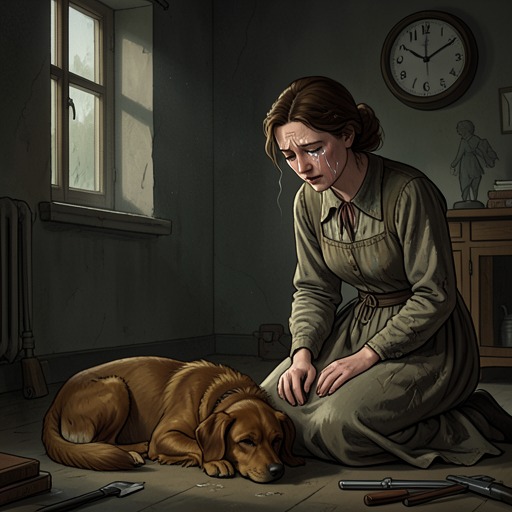
Bonzo is buried in the garden, but Pamela is not told where. For several days the family tries to persuade her that he has run away. She knows that he has not. Their concealment delays formal confirmation but cannot prevent her apprehension of the truth. The gap between what adults say and what Pamela knows gives the episode its particular cruelty: Bonzo’s absence is physically present before his death is openly acknowledged.
Grief and Narrative Significance
Pamela describes losing her beloved and faithful friend as the first time she thinks her heart will break, while recognizing that it will not be the last. The grief is not a decorative response to a minor domestic incident. It establishes the emotional scale by which later wartime losses will be understood. Bonzo’s death is the first personal proof that war reaches into the car park, the garden, the family routine, and the private world of a child.
The later recollection of an overwhelming foreboding at a wedding in Dudley echoes the same pattern of bodily certainty and delayed confirmation that surrounds Bonzo’s death. At the wedding, Pamela becomes ill with a powerful sense of doom and tells Gloria that her beloved boy has just died, though she cannot explain how she could know. The memory preserves Bonzo as an attachment whose disappearance is felt before it can be verified. In this sense, his story joins the book’s wider pattern of wartime separation, in which loved ones vanish, information is withheld, and intuition confronts official silence.
Bonzo also stands apart from the book’s collective scenes of wartime endurance. Bombing can draw strangers together, produce a shared wartime spirit, and lead people to offer help across ordinary social boundaries; public celebrations on VE-Day can fill streets with tables, bunting, Union Jacks, food, fireworks, and bonfires. Bonzo’s death belongs to the opposite register. It is private, uncelebrated, and unredeemed by communal victory. The nation may survive and celebrate, but Pamela’s first beloved companion does not return.
His place in the narrative is therefore both comic and foundational. The stolen walnuts, the four dead chickens, the theatrical begging, the wagging tail at the sound of the horn, and the shadowed car park form a compressed portrait of animal agency, appetite, loyalty, and vulnerability. Bonzo is not merely a symbol of innocence: he is an active, clever, morally dubious dog whose habits affect shopkeepers, neighbours, diners, drivers, and his family. Yet the very specificity of those habits makes the final loss more painful. When Bonzo is gone, the household has lost not an emblem but a singular companion, and Pamela’s broken heart records the first unmistakable cost of the war in her own life.